Scorpion Safety: How to Avoid Stings & Stay Safe
Finding a scorpion in your home can be unsettling, especially when you are not sure what to do next. The good news is that scorpions usually do not go looking for people. Most stings happen when a scorpion is accidentally stepped on, trapped against the skin, or disturbed.
That does not mean you should ignore one.
A little caution can prevent most unwanted encounters. Simple habits such as wearing shoes outdoors, checking clothing and bedding, using a flashlight at night, and keeping scorpions out of your living spaces can make a noticeable difference.
Scorpion safety also means knowing what to do if you are stung. Most scorpion stings in the United States are not life-threatening, but some species can cause serious symptoms. Children are particularly important to watch closely after a sting.
What You Should Know About Scorpion Safety
Scorpions are predators, not animals that normally want to attack humans. They spend much of their time hiding and become more active at night, when they search for food and move around their surroundings.
A scorpion may sting when it feels trapped or threatened. This can happen when someone reaches into a dark space, moves a piece of wood, puts on a shoe containing a hidden scorpion, or accidentally rolls onto one in bed.
The safest approach is simple: do not handle a scorpion with your bare hands.
If you see one, give it space. Move children and pets away from the area and deal with the scorpion carefully rather than trying to grab or crush it.
The level of risk also depends on where you live. The United States has many scorpion species, but the bark scorpion is the species that receives particular attention in Arizona because its sting can cause more serious effects.
If you live somewhere else, the local species may behave differently and have a different level of medical importance.
How to Avoid Getting Stung by a Scorpion
Most scorpion safety comes down to avoiding accidental contact.
You do not need to live in fear or stop using your yard. You simply need to be more careful in places where scorpions may hide.
Wear shoes outside
Avoid walking barefoot outdoors at night, particularly in areas known to have scorpions.
A pair of shoes or boots gives your feet much more protection than bare skin. This is especially important when walking near rocks, wood piles, landscaping materials, sheds, garages, or other areas where scorpions can hide.
Shake out shoes and clothing
Shoes left outside, in a garage, on a porch, or in a closet can become hiding places.
Before putting on shoes that have been sitting unused, turn them upside down and shake them out. Do the same with gloves, jackets, pants, and other clothing that has been left somewhere scorpions can reach.
This is one of the simplest scorpion safety habits to develop. Poison Control and the CDC both recommend checking clothing and footwear in areas where scorpions are common.
Use a flashlight at night
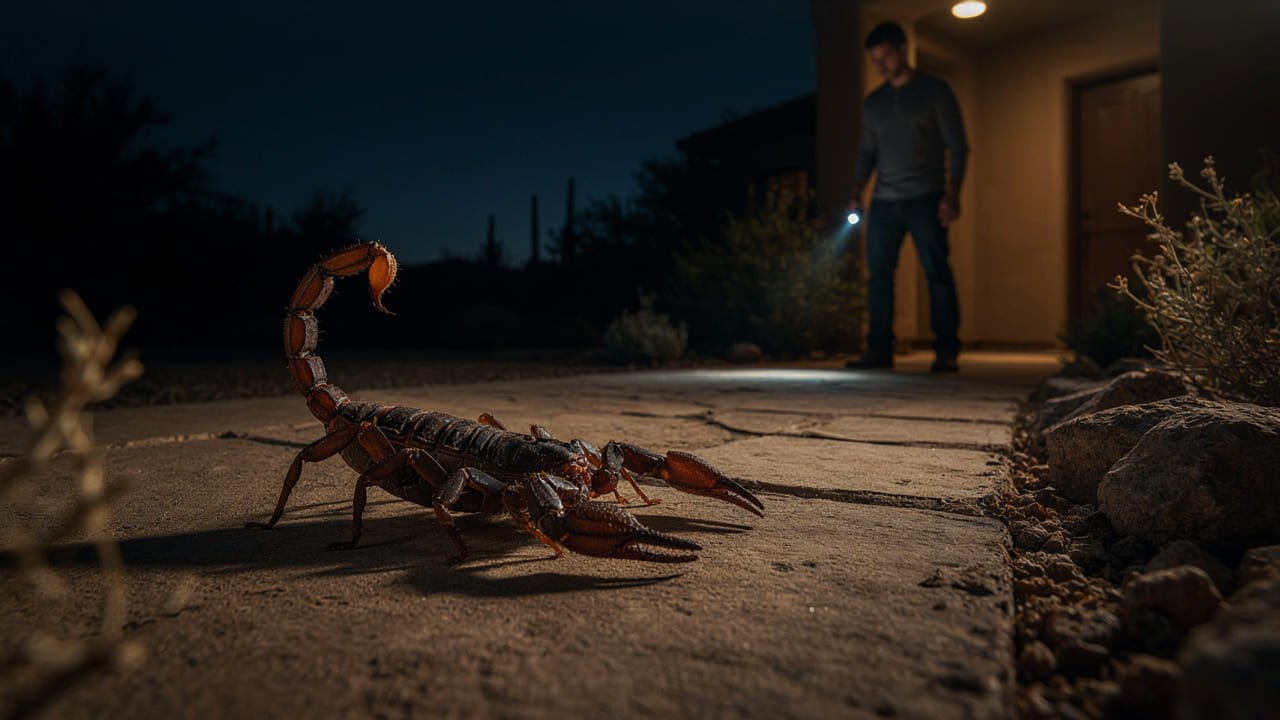
If you live in an area with scorpions, use a flashlight when walking around outside after dark.
Do not assume that a well-lit porch or walkway is automatically free of scorpions. They can remain hidden along walls, under objects, and around landscaping.
A UV or black light can also be useful because many scorpions fluoresce under ultraviolet light. This makes them easier to spot at night.
Wear gloves when moving outdoor materials
Be careful when moving:
- Firewood
- Rocks
- Boards
- Bricks
- Yard debris
- Boxes stored outside
- Garden equipment
- Outdoor furniture
Use sturdy gloves and avoid putting your hands into dark gaps where you cannot see what is inside.
What to Do If You See a Scorpion
The first thing to remember is do not panic.
If the scorpion is across the room, under a piece of furniture, or moving along a wall, keep your distance.
Move children and pets away from the area. Then decide whether you can safely remove it.
If you are comfortable doing so, long-handled tools or tongs can provide distance between you and the scorpion. Poison Control recommends protective footwear and long tongs if a scorpion needs to be captured.
If you are not comfortable handling it, there is nothing wrong with calling a pest professional.
Do not try to pick it up just because it appears slow or harmless.
A scorpion that is sitting still can still sting if it is suddenly touched.
How to Safely Remove a Scorpion From Your Home
There are several ways to deal with a scorpion, but the safest method is the one that keeps your hands and body away from it.
If you have experience handling scorpions, long tongs and a sturdy container can be used carefully. Keep your face and hands away from the scorpion and make sure the container closes securely.
Another option is to contact a pest control professional, especially if you are finding scorpions repeatedly.
Do not corner a scorpion with your bare hands.
Do not attempt to pick it up by the tail.
Do not assume grabbing the pincers will make it safe.
And never let children try to catch one.
If you decide to capture a scorpion for identification, only do so when it can be done without putting yourself at risk. Taking a photo from a safe distance is often a better option.
Should You Kill a Scorpion?
There is no need to chase a scorpion around your house trying to kill it immediately.
Your first priority should be preventing contact.
If you can safely remove the scorpion, that is preferable to taking unnecessary risks. If you cannot safely remove it, close off the area and contact a pest professional.
If you do kill a scorpion, avoid handling the body with bare hands. The stinger can still cause an injury if someone accidentally contacts it.
More importantly, finding a scorpion should make you look at how it got inside.
A single scorpion may simply be a stray visitor. Repeated sightings can point to entry points, outdoor hiding places, or conditions around the home that are making encounters more likely.
Where Scorpion Stings Commonly Happen
Scorpion stings often occur when a person accidentally comes into contact with a hidden scorpion.
Common situations include:
- Walking barefoot at night
- Putting on a shoe containing a scorpion
- Reaching into wood piles
- Moving rocks or debris
- Handling outdoor equipment
- Pulling clothes from the floor
- Sleeping against a wall in an area with scorpions
- Touching a scorpion while trying to remove it
Scorpions can also hide in places that are difficult to notice.
A shoe sitting quietly by the door may look completely harmless. So may a towel left outside overnight.
That is why checking things before using them is more useful than trying to constantly search for scorpions.
How to Check Your Shoes and Clothing for Scorpions
Make checking your shoes part of your routine if you live in a scorpion-prone area.
Before putting them on:
- Pick up the shoe.
- Look inside with a flashlight if needed.
- Turn it upside down.
- Shake it firmly.
- Check around the tongue, sole, and openings.
Do the same with boots that have been sitting in a garage or shed.
Clothing deserves similar attention.
If pants, shirts, jackets, gloves, or towels have been left outdoors, shake them out before using them.
This is especially important when camping or staying in rustic accommodations where scorpions may have easier access.
How to Make Your Bedroom Safer From Scorpions
Nobody wants to find a scorpion in their bedroom.
There are a few simple precautions that can reduce the chance of an unpleasant surprise.
Keep clothing off the floor when possible. Store shoes in a location where they are less likely to become hiding places.
If you live in an area with frequent scorpion activity, check bedding that has been left on the floor or near walls.
It is also worth inspecting the room for possible entry points. Look around doors, windows, baseboards, vents, and wall penetrations.
If you regularly find scorpions in the bedroom, do not simply remove each one and ignore the pattern. Repeated sightings mean it is time to investigate how they are getting inside.
Scorpion Safety at Night
Nighttime deserves extra attention because many scorpion species are more active after dark.
Before walking outside at night, put on shoes.
Use a flashlight around patios, garages, pools, sheds, and landscaping.
If you need to move something outdoors, look before reaching underneath it.
Do not place your hands into cracks, holes, rock piles, or other dark spaces.
If you use a black light to look for scorpions, move slowly and watch the ground, walls, and surrounding objects.
The goal is not to turn nighttime into a hunt every night. It is simply to know what is around you when you are in an area where scorpions are common.
Scorpion Safety Around Children
Children may not understand why a small animal should not be touched.
If you live in an area with scorpions, teach children one simple rule:
If you see a scorpion, do not touch it. Tell an adult.
That rule is easier for a young child to remember than a long explanation.
Keep shoes, gloves, and outdoor toys in places where scorpions are less likely to hide. Check play areas regularly and keep clutter away from areas where children spend time.
Young children deserve extra attention after a suspected scorpion sting because they can be more vulnerable to serious effects from venomous species.
If a child is stung, do not rely on how calm the child appears at first. Contact a poison center or healthcare professional for guidance, particularly if the species is known to be medically significant or symptoms develop.
Scorpion Safety Around Pets
Dogs and cats can turn a scorpion encounter into a much bigger problem because they may try to bite or paw at it.
If your pet spots a scorpion, keep your pet away rather than allowing it to investigate.
Check outdoor areas where your pet spends time, particularly around rocks, wood, landscaping debris, sheds, and other hiding places.
At night, use a flashlight when letting your pet outside in areas where scorpions are common.
If you think your pet has been stung, contact your veterinarian promptly. Do not give your pet human medication unless your veterinarian specifically tells you to do so.
What to Do After a Scorpion Sting
A scorpion sting can hurt immediately.
The area may burn, sting, tingle, or become very sensitive. Symptoms vary depending on the species of scorpion and the person who was stung.
Move away from the scorpion first so you do not get stung again.
Then:
- Wash the area with soap and water.
- Apply a cool compress.
- Keep the affected area comfortable and relatively still.
- Contact a poison center or healthcare professional for advice.
In the United States, Poison Control can be reached at 1-800-222-1222. Their specialists can help determine what to do based on the person’s age, symptoms, and suspected exposure.
If you can safely identify or photograph the scorpion, that information may be useful. Do not risk another sting trying to capture it.
Scorpion Sting First Aid
For a mild sting, basic first aid usually starts with cleaning the area and using a cool compress.
Poison Control recommends washing the sting site with soap and water. A cool compress can help with discomfort.
Do not put the affected area directly into ice water.
Do not cut the skin.
Do not try to suck venom out.
Do not use a tourniquet.
Do not drink alcohol as a way to deal with the sting.
And do not take sedatives unless specifically instructed by a medical professional. The CDC also advises against sedatives after a scorpion sting.
For medication, follow advice from a healthcare professional or poison control center, particularly for children, older adults, people with medical conditions, or anyone experiencing more than mild local symptoms.
When Should You Seek Medical Care for a Scorpion Sting?
Most scorpion stings in the United States are not life-threatening, but serious reactions can occur with certain species.
Get emergency medical help if serious symptoms develop.
Warning signs can include:
- Trouble breathing
- Severe muscle twitching
- Unusual eye movements
- Difficulty speaking
- Drooling
- Severe restlessness
- Staggering or unusual movement
- Severe or spreading symptoms
- Signs of a serious allergic reaction
These symptoms require prompt medical attention.
Young children should be watched particularly closely because serious neurologic symptoms can occur after some venomous scorpion stings.
When in doubt, contact Poison Control or seek medical care rather than trying to guess how serious the sting will become.
What Not to Do After a Scorpion Sting
There are plenty of old home remedies online, but some can make the situation worse or delay appropriate care.
Avoid cutting the sting site.
Do not try to suck out venom.
Do not apply a tourniquet.
Do not put the affected body part directly into ice water.
Do not take sedatives to make yourself sleep through the pain.
Do not ignore symptoms that are spreading beyond the sting area.
And do not spend a long time trying to catch the scorpion if doing so could result in another sting.
Your health matters more than identifying the exact scorpion.
How to Reduce the Risk of Scorpion Stings Outside
Your yard does not have to be completely free of scorpions for it to be safer.
Start by removing places where they can hide close to the house.
Move rocks, boards, lumber, trash, and other debris away from the home’s exterior. Keep grass trimmed and avoid creating piles of material directly against walls.
Firewood is another common concern.
Store it away from the house and avoid bringing large amounts indoors. Shake or inspect individual pieces before handling them when scorpions are common in your area.
Also look at the insects around your home. Scorpions feed on insects and other arthropods, so an outdoor area with abundant prey can make the area more attractive to them.
Scorpion Safety While Hiking and Camping
Scorpion safety matters just as much away from home.
When hiking in areas where scorpions are common, wear closed-toe shoes or boots. Use gloves when moving rocks, logs, or other materials.
At camp, keep clothing and shoes off the ground when possible.
Shake out shoes and clothing before putting them on.
Check sleeping bags and bedding if they have been left outside.
If you are camping in a region known for venomous scorpions, avoid sleeping directly on the ground when practical.
Be particularly careful when reaching underneath rocks, logs, or equipment. A hidden scorpion may react defensively when suddenly disturbed.
Using a Blacklight to Find Scorpions Safely
A blacklight can be a useful tool in areas with scorpion activity because scorpions can fluoresce under ultraviolet light.
People often use UV flashlights to check patios, walls, garages, yards, and other areas after dark.
If you use one, remember that finding a scorpion is only half the job.
Do not walk toward it barefoot.
Do not reach into a hiding place because you see something glowing.
Keep children and pets away while you investigate.
A blacklight should help you see scorpions, not encourage you to get close to them.
Common Scorpion Safety Mistakes
Some of the biggest risks come from small mistakes.
Picking up a scorpion
Even if it appears dead or harmless, do not handle it with your bare hands.
Walking barefoot outside at night
This is an easy way to accidentally step on a hidden scorpion.
Leaving shoes outside
Shoes can provide a dark, protected hiding place.
Reaching under rocks or boards
Never put an unseen hand into a place where a scorpion could be hiding.
Letting children investigate
Children should know to call an adult rather than approaching a scorpion.
Ignoring repeated sightings
One scorpion does not automatically mean your house is infested. But repeated sightings are a reason to inspect entry points and surrounding areas.
Trying random sting remedies
A painful sting can make people reach for whatever home remedy they have heard about. Stick with basic first aid and professional medical guidance instead.
Scorpion Safety Myths
Myth: Scorpions want to attack people
Usually, they do not.
Scorpions generally sting defensively when they are disturbed, trapped, or threatened. Humans are not their normal prey.
Myth: Every scorpion sting is deadly
That is not true.
The seriousness of a sting depends on the species, the amount of venom delivered, and the person who was stung. Most scorpion stings in the United States are not fatal, although some species can cause serious illness.
Myth: A large scorpion is always the most dangerous
Size alone does not tell you how medically important a scorpion is.
Identification matters more than simply judging a scorpion by its size.
Myth: You can safely grab a scorpion by the tail
Do not try it.
A scorpion’s tail contains the stinger, and getting close enough to grab it creates an unnecessary risk.
Myth: If you find one scorpion, hundreds must be hiding nearby
Finding one does not automatically mean you have a large infestation.
It is better to look at the circumstances: where you found it, whether you are seeing others, and whether your home has easy entry points.
How to Create a Scorpion-Safe Home
A safer home starts outside.
Keep debris away from the foundation. Repair damaged screens and seal cracks and openings around doors, windows, pipes, and other potential entry points. Weather-stripping around doors can also reduce gaps that allow scorpions inside.
Inside the home, keep floors and storage areas reasonably clear.
Pay particular attention to:
- Garages
- Closets
- Bedrooms
- Bathrooms
- Attics
- Crawl spaces
- Storage rooms
- Areas around doors and windows
You do not need to turn your house into a laboratory.
The goal is simply to make it harder for scorpions to get inside and harder for them to remain hidden.
If you repeatedly find scorpions despite sealing obvious entry points and cleaning up outdoor hiding places, professional pest control may be worth considering.
A Simple Scorpion Safety Checklist
Use this checklist if you live in an area where scorpions are common:
- Wear shoes outdoors at night.
- Shake out shoes before wearing them.
- Check clothing that has been left outside.
- Wear gloves when moving rocks, wood, and debris.
- Keep children away from scorpions.
- Keep pets away from scorpions.
- Use a flashlight outdoors after dark.
- Consider a UV light for nighttime inspections.
- Keep firewood away from the house.
- Remove clutter around the foundation.
- Repair damaged screens.
- Seal cracks and gaps around the home.
- Do not handle scorpions with bare hands.
- Do not reach into dark gaps without seeing what is inside.
- Know how to contact your local poison center.
- Take suspected stings seriously, especially in young children.
- Seek emergency help if severe symptoms develop.
Final Thoughts
Scorpion safety is mostly about avoiding unnecessary contact.
You do not need to be afraid every time you walk into your garage or step outside at night. A few simple habits can make scorpion encounters much less likely: wear shoes, check clothing and footwear, use a flashlight, keep your hands out of hidden spaces, and never handle a scorpion with your bare hands.
At home, pay attention to repeated sightings. Seal openings, reduce hiding places around the property, and keep areas such as garages and storage spaces under control.
And if someone is stung, do not rely on guesswork. Clean the area, use a cool compress, contact Poison Control or a healthcare professional for advice, and get emergency help if serious symptoms appear.
The safest approach is not complicated. Give scorpions space, remove the easy opportunities for contact, and know what to do if an encounter does happen.
FAQs About Scorpion Safety
Are scorpions aggressive toward humans?
Scorpions generally do not seek out humans. Most stings happen when a scorpion is disturbed, stepped on, trapped against the body, or handled.
Should I walk barefoot in my yard if I have seen scorpions?
It is better not to, particularly at night. Wearing shoes greatly reduces the chance of stepping directly on a scorpion.
Should I check my shoes for scorpions?
Yes. If shoes have been sitting outside, in a garage, shed, porch, or other area where scorpions may enter, shake them out before wearing them.
Can scorpions climb into beds?
Scorpions can climb and may reach beds in some situations, particularly species that are good climbers. Keeping beds slightly away from walls and keeping bedding off the floor can reduce opportunities for contact.
What should I do if I find a scorpion in my bedroom?
Move away from it, keep children and pets out of the room, and avoid trying to grab it. If you can safely remove it using appropriate tools, do so from a distance. Otherwise, contact a pest professional.
What should I do if my child is stung by a scorpion?
Wash the area with soap and water and contact a poison center or healthcare professional for guidance. Watch closely for unusual or worsening symptoms. Young children can be more vulnerable to serious effects from some venomous scorpions.
Can a scorpion sting be treated at home?
Many scorpion stings in the United States can initially be managed with basic first aid and advice from Poison Control. However, symptoms vary by species and person, so medical advice is appropriate, especially for children or anyone with more than mild local symptoms.
Should I put ice directly on a scorpion sting?
Do not put ice directly against the skin for prolonged periods. A cool compress can help with discomfort. The CDC specifically advises using ice rather than submerging the affected area in ice water.
Can I use a blacklight to find scorpions?
Yes. Scorpions can fluoresce under ultraviolet light, making a UV flashlight useful for nighttime inspections. Keep your distance when you find one.
What should I do if I keep finding scorpions inside?
Look beyond the individual scorpion. Check doors, windows, cracks, plumbing penetrations, garages, crawl spaces, and the area around your home’s foundation. Repeated sightings may mean there are several easy entry points or outdoor hiding areas nearby.
When should I call a pest control professional?
Consider professional help when you are finding scorpions regularly, cannot determine how they are entering, or do not feel comfortable removing them yourself.