Scorpion Identification: How to Identify Scorpions by Size, Color, Shape, Markings, and Location
Scorpion Identification – Scorpions are easy to recognize once you know what to look for, but identifying the exact type can be more difficult. Many species have a similar body shape, and their color can change depending on age, location, lighting, and even the surface they are sitting on.
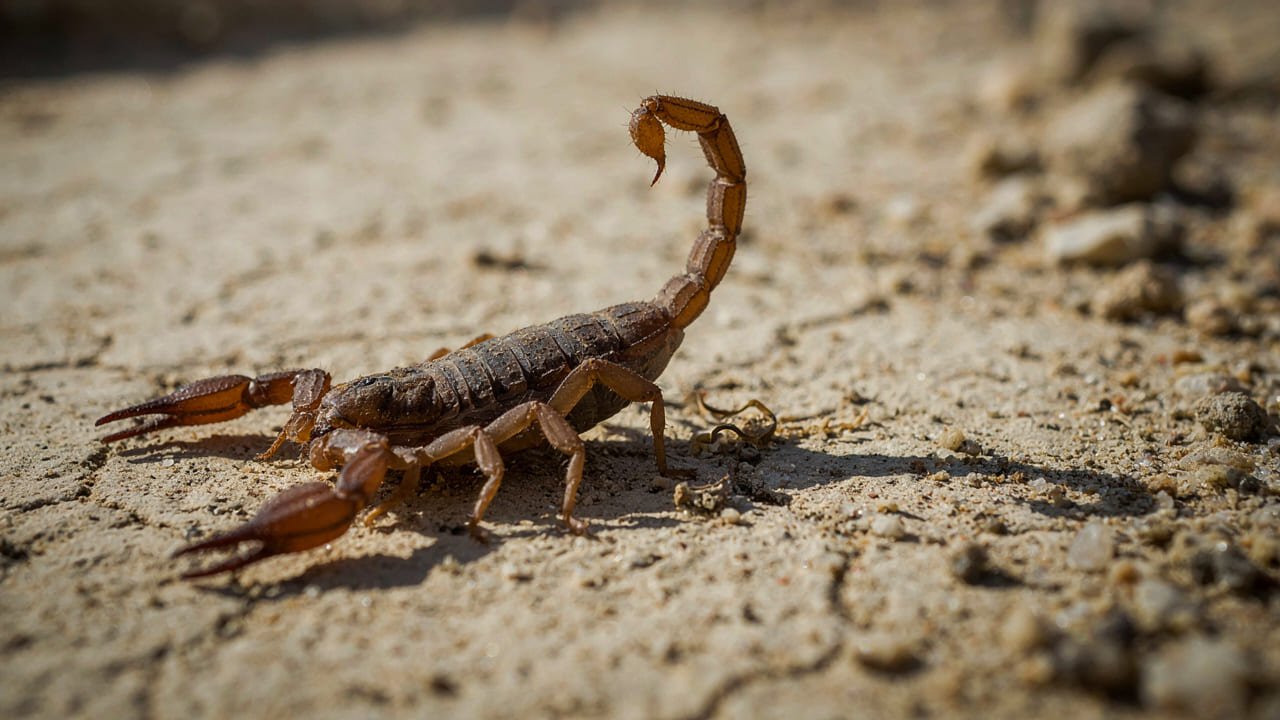
A scorpion has eight legs, a pair of pincers called pedipalps, and a curved tail ending in a stinger. Those basic features can tell you that you are looking at a scorpion, but they do not always tell you which species it is.
Correct identification matters because scorpions vary greatly in size, behavior, habitat, and medical importance. A small, pale scorpion found inside a home may be very different from a large dark scorpion found outdoors.
This guide explains the main features to look at when identifying a scorpion, where common scorpions are found, and what to do if you are unsure about one you find around your home.
How to Identify a Scorpion
Start with the overall shape rather than trying to identify the species immediately.
Look at the body, pincers, tail, legs, color, and size. These features together provide much more useful information than color alone.
A typical scorpion has three main body areas:
- Prosoma: the front section that carries the eyes, mouthparts, legs, and pincers
- Mesosoma: the middle section of the body
- Metasoma: the segmented tail
- Telson: the final part of the tail containing the venom glands and stinger
Scorpions have eight walking legs. Their front pincers are used for grabbing prey and defending themselves, while the tail is raised when the animal feels threatened.
Look at the Pincers
The pincers are one of the first features worth examining.
Some scorpions have relatively large, powerful pincers compared with their body. Others have narrow, slender pincers.
As a general rule, species with large robust pincers often rely more heavily on those pincers when handling prey. Species with slender pincers may depend more on their venom.
Pincer shape can help with identification, but it should not be used by itself.
Examine the Tail
The tail is another useful feature.
Look at:
- The number and shape of the tail segments
- Whether the tail is thick or slender
- How large the tail appears compared with the body
- The shape of the final segment
- The size and appearance of the stinger
Some species have a relatively thick tail, while others have a noticeably slender one.
Do not handle a scorpion to examine these features more closely. A photograph taken from a safe distance is usually a better option.
Scorpion Color and Markings
Color can be useful, but it is one of the easiest identification features to misunderstand.
Scorpions can be tan, yellow, brown, reddish, gray, or almost black depending on the species. Individuals can also look different from one another.
Young scorpions may not have the same appearance as adults. Lighting can also make a pale scorpion appear darker than it really is.
Look for markings as well as the basic body color.
Some scorpions have:
- Dark bands
- Spots
- Stripes
- Darker pincers
- A darker tail
- A lighter body
- A combination of several shades
Never identify a scorpion based only on the color you see in a quick glance.
How Big Are Scorpions?
Scorpion size varies considerably.
Some species remain relatively small, while others can grow several inches long. The size of an individual can also depend on its age.
When estimating size, compare the scorpion with something nearby rather than guessing.
For example, if you photograph a scorpion next to a ruler without getting close to it, the image can provide useful information for later identification.
Remember that a small scorpion is not automatically harmless, and a large scorpion is not automatically more dangerous.
Where Scorpions Are Found
Scorpions live in many parts of the world, especially warm and dry regions.
They are found in parts of:
- The southwestern United States
- Mexico
- Central America
- South America
- Africa
- The Middle East
- India
- Australia
- Other warm regions around the world
Different species prefer different environments.
Some live in deserts and rocky areas. Others live in grasslands, forests, mountains, or areas around human homes.
Finding a scorpion indoors does not necessarily mean it lives inside the house. It may have entered while searching for food, water, shelter, or a cooler place to hide.
Common Scorpions in the United States
The United States has several scorpion species, with the greatest variety occurring in the warmer western and southwestern states.
Arizona Bark Scorpion
The Arizona bark scorpion is one of the best-known scorpions in the United States.
It is usually light brown or tan and has relatively slender pincers and a slender tail. It can climb walls and other surfaces and may be found around homes, garages, bathrooms, and other sheltered areas.
It is particularly important to recognize in Arizona because its sting can cause more significant symptoms than the sting of many other scorpion species found in the region.
Desert Hairy Scorpion
The desert hairy scorpion is considerably larger and more robust than the Arizona bark scorpion.
It generally has a darker appearance and noticeable hairs covering parts of its body and legs.
Despite its intimidating size, size alone does not tell you how medically important a sting will be.
Stripe-Tailed Scorpion
The stripe-tailed scorpion gets its common name from markings associated with its tail.
It can occur in parts of the southwestern United States and may be encountered around rocks, wood, debris, and other sheltered areas.
As with other scorpions, identification should rely on several physical characteristics rather than one marking.
Scorpions in Arizona
Arizona is particularly well known for scorpions.
Several species occur throughout the state, and residents may encounter them around homes, garages, yards, gardens, sheds, and outdoor structures.
The Arizona bark scorpion is especially important because it is an excellent climber and can enter buildings through surprisingly small openings.
Scorpions may become more noticeable during warm weather and at night when they become active.
If you live in Arizona and regularly find scorpions around your home, identification can help you understand which species you are dealing with and how seriously to treat a sting.
Scorpions in Other States
Scorpions are not limited to Arizona.
They can also be found in states including:
- California
- Nevada
- Utah
- New Mexico
- Texas
- Colorado
- Oklahoma
- parts of Kansas
- parts of Missouri
- other southern and western areas
The species and level of risk vary from one region to another.
If you find a scorpion, consider your location along with its physical characteristics. A species that is common in Arizona may not be the same species commonly found in Texas or California.
How to Tell a Scorpion From Other Arthropods
Sometimes people mistake other creatures for scorpions, especially when they see something quickly moving across the floor at night.
The easiest way to confirm a scorpion is to look for the combination of:
- Eight legs
- Two front pincers
- A segmented tail
- A stinger at the end of the tail
Spiders have eight legs but do not have pincers like a scorpion or a long segmented tail ending in a stinger.
Pseudoscorpions can cause confusion because they have pincers, but they are extremely small and do not have the long tail and stinger of a true scorpion.
Do Scorpions Glow Under Black Light?
Many scorpions fluoresce under ultraviolet light.
When exposed to a suitable UV or black light, their bodies can appear bright blue-green or another fluorescent color.
This is one reason people use UV flashlights when searching for scorpions around homes and outdoor areas at night.
However, fluorescence is useful for locating scorpions, not for identifying the exact species.
A UV light can help you spot a scorpion hiding near a wall, under furniture, around rocks, or in other dark areas. It does not replace proper identification.
How to Safely Photograph a Scorpion
If you want help identifying a scorpion, a clear photograph can be extremely useful.
You do not need to get close.
Take the photo from a safe distance and try to capture:
- The entire body
- Both pincers
- The tail
- The stinger
- The back and side of the animal if possible
- Any obvious markings
If you can safely include an object for scale, that can also help estimate its size.
Do not pick up, trap, or corner a scorpion just to get a better photograph.
Can You Identify a Scorpion From a Photo?
Sometimes, yes.
A clear photograph can provide enough information to narrow down the possibilities, especially when the location is known.
But photographs are not always sufficient for a definite species identification. Poor lighting, missing body parts, unusual angles, and similar-looking species can make identification difficult.
If the identification matters because someone has been stung, do not delay medical advice while trying to identify the scorpion.
Scorpion Identification by Location
Location is an important part of identification.
If you are trying to identify a scorpion, record where you found it.
For example:
Indoor location: bathroom, bedroom, garage, basement, attic, kitchen, or another room.
Outdoor location: under rocks, near a woodpile, around a shed, beneath outdoor furniture, in landscaping, or near a foundation.
Also note your general region or state.
A scorpion found inside a Phoenix home should be considered differently from one found inside a home in Texas or southern California because different species occur in different areas.
Scorpion Identification at Night
Scorpions are primarily nocturnal, so many people first notice them after dark.
If you are checking your property at night, a UV flashlight can make scorpions easier to spot because of their fluorescence.
Move slowly and scan areas where scorpions may hide.
Pay particular attention to:
- Walls and foundations
- Rocks
- Wood piles
- Garage floors
- Around outdoor storage
- Under furniture
- Dark corners
- Areas around doors
- Landscaping materials
Avoid reaching into dark spaces with your hands.
Identifying a Scorpion in Your House
Finding a scorpion indoors can be alarming, especially if you have children or pets.
Before trying to remove it, keep people and animals away from the area.
Do not walk barefoot around the room while searching for it. Turn on the lights and use a flashlight to check nearby areas.
If the scorpion disappears, check likely hiding places from a safe position rather than moving furniture or putting your hands into dark spaces.
Finding one scorpion does not automatically mean there are many more inside your house. However, repeated sightings can indicate that there are entry points, shelter, food, or moisture conditions that are making the property attractive to scorpions.
What Attracts Scorpions to a Home?
Scorpions are not usually entering a home because they are attracted to people.
They may enter while searching for:
- Food
- Water
- Shelter
- Cooler or warmer conditions
- Protection from weather
Homes can also provide plenty of hiding places.
Outdoor lighting may indirectly contribute to scorpion activity because lights attract insects, and insects can provide a food source for scorpions.
This is one reason controlling insects around your home can be part of a broader scorpion prevention plan.
Are All Scorpions Dangerous?
No.
Scorpion stings vary in severity. Most species are not considered medically dangerous to healthy adults, but some species can cause significant symptoms.
The level of risk depends on the species, the amount of venom delivered, the person who was stung, and other factors.
Children, older adults, and people with certain medical conditions may need particular caution after a sting.
If someone develops severe or unusual symptoms after a scorpion sting, seek medical help promptly.
What to Do If You Find a Scorpion
The safest approach is to give it space.
Keep children and pets away and avoid touching it with your hands.
If you can safely photograph it, take a picture from a distance. This may help with identification later.
If you need to remove the scorpion, use a method that keeps your hands and body away from it. If you are uncomfortable doing this, contacting a pest professional is a safer choice.
Afterward, inspect the area for possible entry points and consider why the scorpion was able to get inside.
What to Do After a Scorpion Sting
If you are stung, move away from the scorpion and get to a safe location.
Wash the area gently with soap and water and monitor your symptoms.
Pain, tingling, swelling, or other symptoms can occur after a sting. More serious symptoms can require urgent medical attention.
Seek emergency medical care if the person has trouble breathing, severe muscle movements, difficulty swallowing, significant weakness, loss of consciousness, or other serious symptoms.
If the person stung is a young child or another person at higher risk, contact a healthcare professional for guidance.
Do not rely on an internet photo to decide whether medical care is necessary.
Why Correct Identification Matters
Knowing what kind of scorpion you are dealing with can make prevention easier.
For example, if you live in an area where climbing scorpions are common, checking walls, ceilings, doors, and other elevated areas may be particularly important.
If the species commonly lives outdoors under rocks or debris, removing those hiding places around the property may reduce encounters.
Identification also helps you understand the potential significance of a sting.
Still, you should never take unnecessary risks just to identify a scorpion perfectly.
Frequently Asked Questions
How can I identify a scorpion?
Look at its body shape, pincers, tail, stinger, color, markings, size, and location. A clear photograph can help, but some species require expert identification.
What does a scorpion look like?
A scorpion has eight legs, two front pincers, a segmented tail, and a stinger at the end of its tail.
What color are scorpions?
Scorpions can be tan, yellow, brown, reddish, gray, or dark depending on the species. Color alone is not reliable enough for identification.
How big can scorpions get?
Scorpion size varies widely by species. Some are quite small, while others can reach several inches in total length.
Do scorpions glow under black light?
Yes. Many scorpions fluoresce under ultraviolet light, which can make them easier to locate at night.
Is a small scorpion dangerous?
Not necessarily. Size does not reliably indicate how medically important a scorpion sting may be.
Are Arizona scorpions dangerous?
Some Arizona species can cause more serious symptoms than others. The Arizona bark scorpion is particularly important because its sting can produce significant neurological symptoms.
Can scorpions come into houses?
Yes. Scorpions can enter buildings through cracks, gaps around doors and windows, openings around pipes, and other small entry points. Some species are also good climbers.
Does finding one scorpion mean there are more?
Not necessarily. One scorpion may have entered by chance. Repeated sightings, however, can indicate conditions around the home that are supporting scorpion activity.
Should I pick up a scorpion to identify it?
No. There is no good reason to handle a live scorpion with your hands. Photograph it from a safe distance instead.
Final Thoughts
Scorpion identification starts with the basics: eight legs, two pincers, a segmented tail, and a stinger. From there, size, color, markings, pincer shape, tail shape, behavior, and location can help narrow down the possibilities.
If you find a scorpion in or around your home, you do not need to get close to it to learn more about it. A clear photograph, the location where you found it, and a few details about its appearance can often provide useful clues.
Most importantly, identification should never come before safety. Keep your distance, protect children and pets, and treat an unexplained sting seriously if significant symptoms develop.