
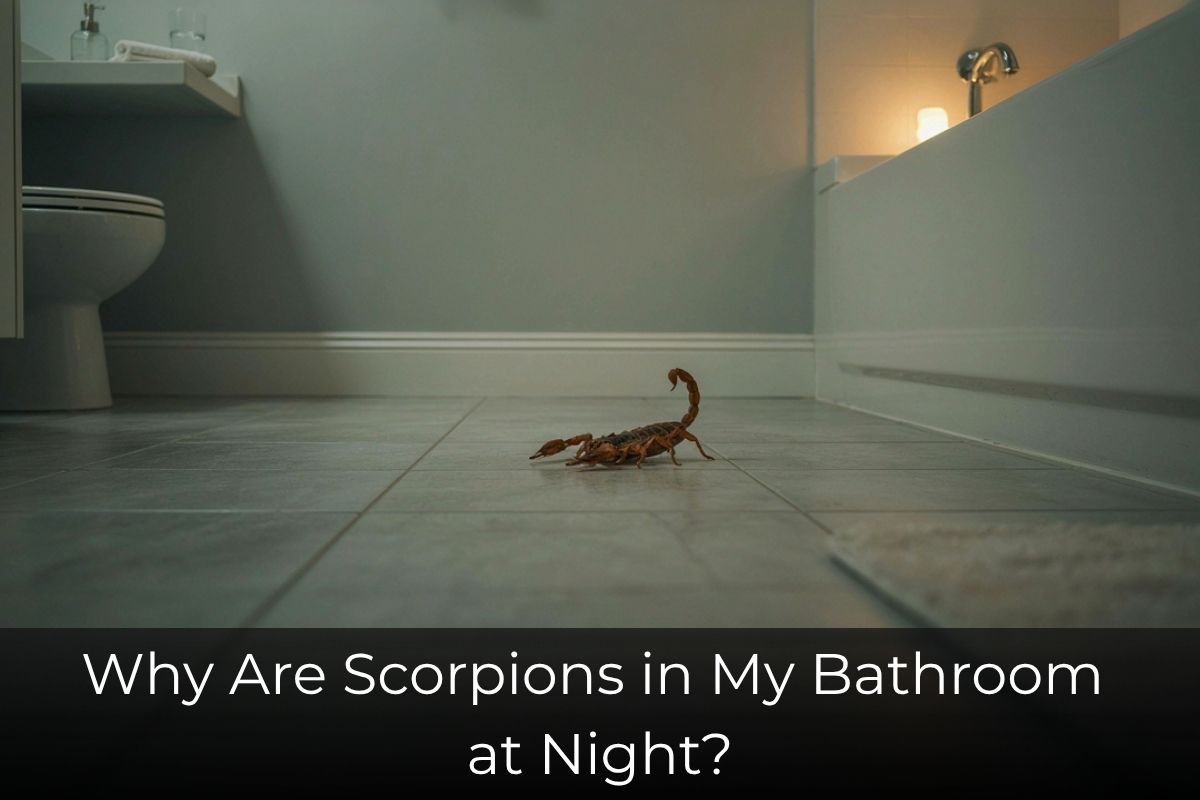
Why are scorpions in my bathroom at night? Learn why they enter bathrooms, how they get inside, where they hide, and what you can do to keep them out.
Why are scorpions in my bathroom at night? In most cases, it comes down to a combination of food, moisture, shelter, temperature, and easy access. Scorpions are primarily nocturnal, so it is common to discover one in a bathroom after the lights have been off for several hours. A bathroom can provide a dark, quiet place with moisture and insects nearby, while cracks, gaps, plumbing openings, doors, and other small entry points can give a scorpion a way inside.
Finding a scorpion beside the bathtub, near the toilet, under a sink, or on the bathroom floor can be alarming. It is especially unsettling when you thought your home was sealed and secure.
The good news is that seeing a scorpion in the bathroom does not automatically mean your home is infested. A single scorpion may have wandered inside while searching for food or shelter. However, repeated sightings are a reason to look more closely at possible entry points and the conditions around your home.
Why Are Scorpions in the Bathroom at Night?
Scorpions are well adapted to nighttime activity. During the day, many species remain hidden in protected areas to avoid heat, direct sunlight, and predators. Once temperatures drop and the environment becomes quieter, they emerge to hunt.
Bathrooms can provide several things a scorpion may be looking for.
Bathrooms can offer moisture
Scorpions do not normally need to drink large amounts of water, but moisture can still make certain areas around a home attractive, especially in dry environments.
A bathroom may have condensation, damp floors, wet bath mats, plumbing leaks, or moisture around sinks and tubs. These conditions can also support insects, which are a much more important attraction because insects are common scorpion prey.
This does not mean a wet bathroom automatically attracts scorpions. Instead, moisture can contribute to an environment where both scorpions and their prey may find suitable conditions.
Bathrooms can contain insects
Scorpions are predators. Their diet commonly includes insects and other small arthropods.
If small insects are regularly present in your bathroom, a scorpion may have a reason to investigate the area. Small bugs can enter through windows, vents, cracks, plumbing openings, and gaps around doors.
This is one reason controlling the insects around your home can be an important part of scorpion prevention.
Bathrooms are often dark and quiet
Scorpions generally prefer protected places where they are less likely to be disturbed.
At night, a bathroom can become an ideal temporary hunting area. Once the lights are off and people are asleep, a scorpion can move around looking for prey without much disturbance.
A bathroom may also contain hiding places beneath cabinets, behind fixtures, under mats, around plumbing, and along wall edges.
Bathrooms can provide access points
A scorpion does not need a large opening to enter a home.
Depending on the species and the size of the individual, surprisingly small gaps can provide access. Gaps beneath doors, cracks around windows, openings around plumbing, damaged screens, and spaces around utility lines can all deserve attention.
The bathroom itself may not be the original entry point. A scorpion could enter the home somewhere else and eventually make its way into the bathroom.
Are Scorpions Coming Up Through the Bathroom Drain?
One of the first things many homeowners wonder after seeing a scorpion near a bathtub or shower drain is whether it came through the drain.
It is possible for small arthropods to move through plumbing systems under certain conditions, but a bathroom drain should not automatically be assumed to be the source of a scorpion sighting.
Modern plumbing systems contain water traps and other features that make direct movement through a drain less straightforward than it may appear.
A scorpion found beside a drain may simply have been attracted to the surrounding area or may have entered the bathroom through another opening.
For example, check:
- Gaps around pipes under the sink
- Openings where plumbing enters the wall
- Cracks around the base of cabinets
- Gaps around doors
- Damaged window screens
- Wall cracks
- Floor-to-wall gaps
- Bathroom vents
- Openings around utility lines
If you repeatedly find scorpions around the same drain, however, it makes sense to inspect the plumbing area and surrounding openings carefully.
How Do Scorpions Get Into a Bathroom?
Scorpions can enter homes through several routes. The exact route depends on the building, surrounding landscape, species, and condition of the structure.
Gaps under doors
A bathroom door itself usually is not the outdoor entry point, but exterior doors can be.
If an outside door has a large gap underneath it, a scorpion may be able to enter the house and then travel through the interior.
Check exterior doors for:
- Damaged door sweeps
- Uneven thresholds
- Gaps at the corners
- Cracks around the frame
- Poorly sealed weather stripping
Replacing worn door sweeps and weather stripping can reduce opportunities for pests to enter.
Cracks around windows
Windows are another common place to inspect.
Look at the screen, frame, sill, and surrounding wall. Even if the glass is closed, gaps around the frame can sometimes provide access.
Make sure window screens fit properly and do not have tears or loose edges.
Openings around pipes
Bathrooms have numerous plumbing penetrations.
Pipes may pass through walls, floors, cabinets, or ceilings. If there are large gaps around those openings, they can become pathways for insects and other pests.
Look underneath sinks and behind removable access panels. Seal appropriate gaps with a suitable building sealant while avoiding anything that could interfere with plumbing maintenance or ventilation.
Cracks in walls and floors
A small crack may not seem important, but repeated pest activity around the same area is worth investigating.
Pay particular attention to cracks near:
- Baseboards
- Door frames
- Bathroom cabinets
- Plumbing
- Windows
- Floor transitions
- Exterior walls
Vents and other openings
Bathrooms often have exhaust fans and ventilation openings.
These should have properly fitted covers and screens where appropriate. Do not block required ventilation openings simply to prevent pests.
Instead, inspect the exterior vent cover and surrounding area for damage or gaps.
Where Do Scorpions Hide in a Bathroom?
If you have seen one scorpion, you may immediately wonder where another one could be hiding.
Scorpions prefer dark, sheltered locations. During the day, one may remain hidden rather than sitting in the middle of an open bathroom.
Common places worth checking include:
Under bathroom mats
Bath mats provide darkness and shelter close to the floor.
Shake out mats carefully and keep them dry when possible. If you live in an area where scorpions are common, avoid leaving piles of clothing, towels, or other items on the floor.
Under cabinets
The space beneath bathroom cabinets can be dark and undisturbed.
Look for gaps around the bottom edge, plumbing openings, and wall connections.
Behind toilets
The area behind a toilet can be relatively quiet and protected.
Inspect carefully around the base and nearby wall or plumbing openings.
Around bathtubs
Scorpions may move along edges and corners while searching for prey.
Inspect gaps around the tub, wall joints, access panels, and nearby floor areas.
Around plumbing
The space around pipes is particularly important because plumbing penetrations can create gaps between rooms and wall cavities.
Along walls and corners
Scorpions often move close to edges rather than crossing large open spaces.
Check baseboards, corners, behind storage items, and other areas that remain undisturbed.
Does a Clean Bathroom Prevent Scorpions?
Keeping your bathroom clean is useful, but cleanliness alone will not guarantee that scorpions stay away.
Scorpions are not attracted to dirt in the same way some household pests are. The bigger issue is the combination of access, shelter, prey, moisture, and surrounding habitat.
You can have a spotless bathroom and still occasionally find a scorpion if there are easy entry points around the home.
Cleaning should therefore be part of a broader prevention plan rather than the only solution.
Keep floors and mats dry, remove clutter, fix plumbing leaks, and reduce insect activity. At the same time, inspect the structure for places where pests can get inside.
Why Do I Only See Scorpions at Night?
Seeing scorpions at night is not unusual.
Many scorpion species are nocturnal. They remain hidden during the hottest or brightest parts of the day and become active after dark.
This behavior can make a scorpion seem like it appeared suddenly.
It may have been inside or nearby for hours without being noticed.
Nighttime also gives scorpions better opportunities to hunt. Their prey may become active at night as well, creating more opportunities for a predator to move around.
This is why turning on the bathroom light late at night can sometimes reveal a scorpion that you would never have noticed during the day.
Why Are Scorpions Coming Into My House?
A scorpion entering your home is usually not there because it wants to interact with people.
It is more likely responding to environmental conditions.
Some common reasons include:
Searching for prey
If insects are active around your home, scorpions may follow the food supply.
Outdoor lighting can attract insects, and insects around doors and windows can create a food source close to potential entry points.
Seeking shelter
Scorpions spend much of their time hiding.
A home can provide protected spaces, especially around foundations, garages, storage areas, wall gaps, and clutter.
Escaping extreme outdoor conditions
In hot, dry regions, the area around a home may offer more favorable shelter than exposed ground.
This does not mean every scorpion entering a house is escaping heat. Different species and local conditions behave differently.
Following favorable habitat
Landscaping can sometimes create conditions that support scorpions or their prey.
Wood piles, rocks, dense vegetation, debris, and clutter near exterior walls can provide hiding places.
Does Finding One Scorpion Mean There Are More?
Not necessarily.
Finding one scorpion does not prove that several others are inside your house.
A single individual may have entered through a gap while hunting. It could have come inside from nearby outdoor habitat without establishing itself indoors.
However, repeated sightings should not be ignored.
If you are finding scorpions several times a week, seeing them in different rooms, or regularly discovering them in bathrooms and bedrooms, investigate the home and surrounding property more carefully.
Look for:
- Multiple entry points
- Insect activity
- Exterior cracks
- Gaps beneath doors
- Clutter around the foundation
- Rocks, wood, or debris near walls
- Damaged screens
- Poorly sealed utility openings
Repeated sightings can tell you more than a single encounter.
What Should I Do If I Find a Scorpion in the Bathroom?
Your first priority should be to avoid getting stung.
Do not pick up a scorpion with your bare hands, even if it appears slow or dead.
Keep children and pets away from the area until the scorpion has been safely dealt with.
If you are comfortable doing so, you can use a long-handled tool or another safe method to remove it while keeping your hands and body away from the animal.
Some homeowners use a container and a stiff piece of cardboard to capture and relocate a scorpion. However, only attempt this if you can do so without getting close enough to be stung.
If you are unsure what species you are dealing with or do not feel comfortable handling it, contacting a local pest professional is the safer option.
If someone is stung and develops concerning symptoms, seek medical advice promptly. Severe reactions can require emergency medical attention.
How to Keep Scorpions Out of Your Bathroom
Preventing future sightings is usually more effective than dealing with individual scorpions one at a time.
Seal gaps around plumbing
Inspect the areas where pipes enter walls and floors.
Seal appropriate gaps with suitable materials, while keeping access to plumbing components that require maintenance.
Install or replace door sweeps
Exterior doors should close tightly against the threshold.
A damaged or missing door sweep can leave an easy pathway for crawling pests.
Repair window screens
Check every bathroom window for tears, loose edges, and gaps.
A properly fitted screen can reduce access for insects and other pests.
Reduce insects around the home
Because scorpions prey on insects, reducing the food supply around your property can help make the area less attractive.
Address obvious sources of insect activity, particularly around exterior lights, doors, windows, trash areas, and landscaping.
Remove outdoor hiding places
Keep wood piles, debris, rocks, and other potential hiding places away from exterior walls where practical.
Trim vegetation that touches the structure and keep areas around the foundation reasonably open.
Reduce unnecessary outdoor lighting
Outdoor lights can attract insects, which can in turn provide prey for scorpions.
Where practical, use lighting that minimizes unnecessary insect attraction and avoid leaving lights on all night when they are not needed.
Keep bathrooms dry and uncluttered
Fix leaks and avoid leaving damp towels, mats, or piles of clothing on the floor.
A tidy bathroom is easier to inspect and makes it easier to notice new pest activity.
Should You Use Insecticide for Scorpions?
Chemical treatment can sometimes be part of a professional pest-management program, particularly in areas where scorpions are common.
However, spraying random areas inside a bathroom is not necessarily the best first step.
The more useful question is why scorpions are reaching the house in the first place.
If insects are abundant around the property or the building has numerous entry points, treating only the bathroom may not solve the underlying problem.
For persistent activity, a licensed pest professional can evaluate the property, identify likely entry points, and recommend an appropriate treatment based on local regulations and the species involved.
Always follow the pesticide label. Never use a product indoors unless its label specifically permits indoor use in that location.
Does Bleach Kill Scorpions?
Bleach is not a good choice for dealing with a scorpion.
It is a household cleaning chemical, not a general-purpose scorpion control method. Using bleach around a live scorpion can also create unnecessary exposure to a chemical while putting you close to an animal that may sting.
Do not mix bleach with other cleaning products. Some combinations can produce dangerous gases.
If you find a scorpion in the bathroom, focus on safe removal and prevention rather than trying to kill it with household chemicals.
Does Killing a Scorpion Attract More Scorpions?
Killing a scorpion does not generally mean that more scorpions will be attracted to the location because you killed it.
This is a common concern, but the bigger issue is usually the environment that allowed the scorpion to be there in the first place.
If you repeatedly find scorpions, look for conditions that may support them or their prey instead of assuming the dead scorpion itself is attracting others.
That means checking entry points, insects, outdoor shelter, clutter, landscaping, and gaps around the structure.
When Should You Call a Pest Professional?
An occasional scorpion may not require professional treatment, particularly if you can identify and correct an obvious entry point.
Professional help becomes more useful when sightings are frequent or increasing.
Consider contacting a qualified pest professional if:
- You regularly find scorpions indoors
- You see them in several rooms
- You find them around bedrooms
- You have difficulty identifying entry points
- Scorpion activity is increasing
- Children or pets may be exposed
- You live in an area with medically significant scorpion species
- DIY prevention has not reduced sightings
A professional can inspect both the structure and the surrounding property instead of treating only the room where you found the scorpion.
Bathroom Scorpion Prevention Checklist
If you want a simple starting point, work through this checklist:
Inside the bathroom
- Check around pipes and plumbing openings.
- Inspect cracks around baseboards.
- Look behind and beneath cabinets.
- Check around the bathtub and toilet.
- Remove unnecessary floor clutter.
- Keep mats and towels dry.
- Fix leaks and persistent moisture problems.
- Check bathroom windows and screens.
- Inspect ventilation openings.
Outside the bathroom
- Check exterior doors and door sweeps.
- Seal appropriate cracks around the structure.
- Inspect window frames.
- Reduce insect activity near doors and windows.
- Move debris away from exterior walls.
- Keep wood piles away from the house where practical.
- Trim vegetation touching the building.
- Reduce unnecessary outdoor lighting.
You do not need to complete everything in one day. Start with the easiest entry points and the areas where you have actually seen scorpion activity.
Frequently Asked Questions
Why are scorpions in my bathroom at night?
Scorpions are primarily nocturnal, so they are more likely to be active after dark. A bathroom may offer shelter, moisture, and access to insects, while cracks and openings can allow a scorpion to enter the home.
Can scorpions come through bathroom drains?
It is possible for small arthropods to move through some plumbing environments, but a scorpion found near a drain does not necessarily mean it came through the drain. Inspect gaps around plumbing, walls, doors, windows, and other entry points as well.
Why do I keep finding scorpions in my bathroom?
Repeated sightings can indicate that your home has accessible entry points or that conditions around the property support scorpion activity. Look for gaps, insect activity, clutter, outdoor shelter, and openings around plumbing and windows.
Are scorpions attracted to water?
Moisture can be one factor around a home, especially in dry environments, but scorpions are predators and food availability is also important. A damp bathroom may support insects that scorpions hunt.
Where do scorpions hide during the day?
They may hide in dark, protected spaces such as cracks, gaps, beneath objects, around foundations, under debris, and other sheltered locations. Indoors, they can remain hidden beneath or behind bathroom fixtures and furniture.
Does a clean house prevent scorpions?
Not completely. Good housekeeping helps reduce clutter and insects, but scorpions can still enter a clean home through structural gaps and openings.
Does killing one scorpion attract more?
No. Killing one scorpion does not normally attract additional scorpions. If more appear, the likely explanation is that the surrounding environment or structure is allowing continued access.
Does bleach kill scorpions?
Bleach is not an appropriate scorpion-control method. It can create unnecessary chemical exposure and should never be mixed with other cleaning products. Use a safer removal method or contact a professional if necessary.
Should I worry if I find one scorpion?
Finding one does not automatically mean you have an infestation. However, it is worth checking the area for entry points and making basic prevention improvements, particularly if scorpions are common where you live.
Are scorpions dangerous?
The risk depends on the species and the person or animal that is stung. Some stings cause localized pain and other symptoms, while certain species can cause more serious reactions. If a sting causes severe or unusual symptoms, seek medical attention.
Can scorpions climb walls?
Many scorpions are capable of moving across various surfaces, although their climbing ability varies by species and surface. This is one reason sealing gaps at different heights and checking walls, windows, and plumbing openings can be important.
Why do I see scorpions more often during summer?
Warmer weather can increase activity in many scorpion species and their prey. Seasonal conditions can therefore lead to more sightings around homes, although activity patterns vary depending on species and local climate.
Final Thoughts
Finding a scorpion in the bathroom at night can be unsettling, but there is usually a reason it ended up there.
The combination of nighttime activity, available prey, shelter, moisture, and access points can make a bathroom an attractive place for a wandering scorpion. The scorpion may have entered through a small gap somewhere around the house rather than coming directly through the bathroom drain.
The most useful response is to look beyond the individual scorpion.
Check the bathroom for plumbing gaps, cracks, damaged screens, and other openings. Then look outside for insects, clutter, wood, rocks, vegetation, and other conditions close to the home that may support scorpion activity.
If you only see one occasionally, basic prevention may be enough. If sightings become frequent or you are finding scorpions throughout the home, a professional inspection can help identify the source and determine the safest way to manage the problem.
A bathroom should be one of the easier places in your home to inspect. Start there, find the possible entry points, and work outward from the room to the rest of the property.

Ravi Rathore writes practical, easy-to-understand guides about scorpions, home prevention, identification, and safety. ScorpionGuide focuses on helping homeowners and outdoor enthusiasts better understand scorpion behavior and reduce unwanted encounters.