
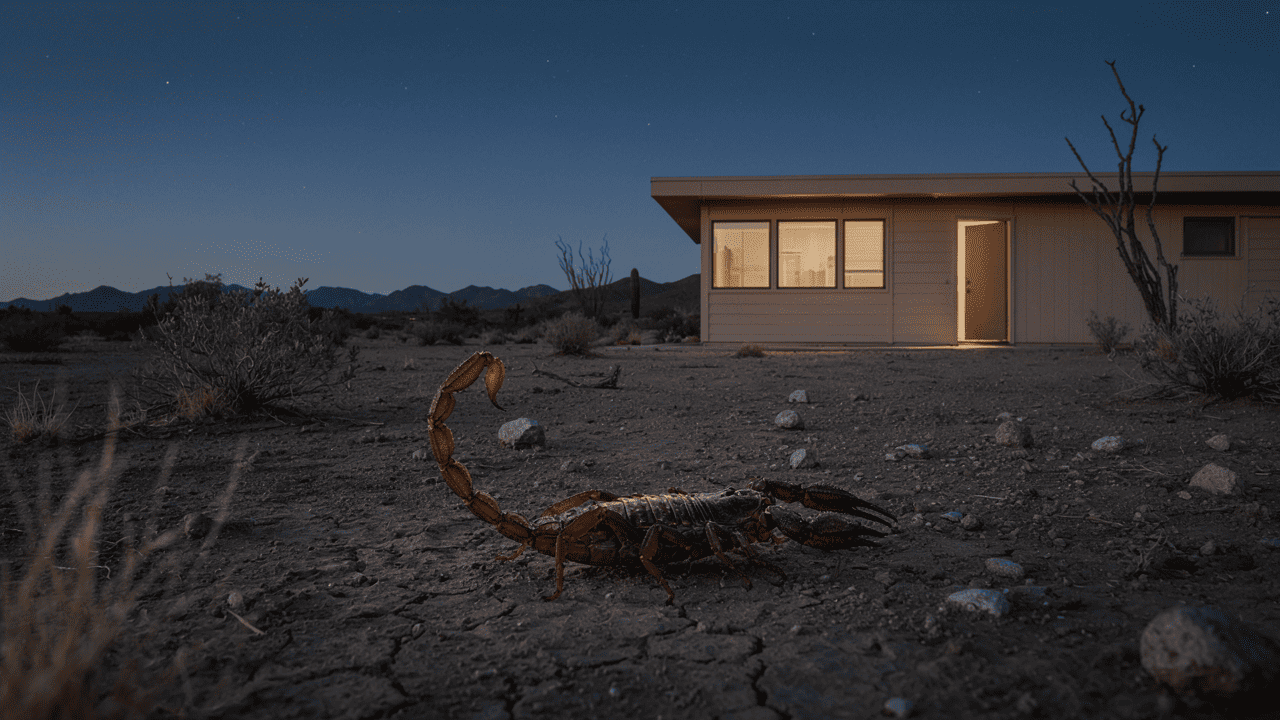
Why Are Scorpions Coming Into My House
Why are scorpions coming into my house? If you keep finding scorpions indoors, there is usually a reason they are getting close to your home. Scorpions may enter through small gaps around doors, windows, pipes, or other openings, while outdoor clutter, insects, moisture, and nearby hiding places can make your property more attractive to them. Finding one does not always mean your house is infested, but repeated sightings are a good reason to look at what may be attracting them and how they are getting inside.
Scorpions are mostly nocturnal, so many homeowners never see them until nighttime. They can spend the day hiding under rocks, wood, debris, or other protected areas and become active after dark. Some species are also good climbers and can move across walls and other surfaces.
The good news is that finding scorpions does not mean you have to live with them. In many cases, reducing hiding places, controlling insects, sealing entry points, and making a few changes around the house can reduce encounters.
Why Are Scorpions Coming Into My House?
Scorpions do not enter homes because they are specifically looking for people. They are usually looking for food, shelter, water, or a suitable place to move through.
A house can accidentally provide several of these things at once.
Common reasons include:
- Small gaps around doors and windows
- Damaged screens or door sweeps
- Cracks around walls and foundations
- Insects and spiders inside or around the house
- Wood piles and outdoor debris
- Rocks and landscaping close to the foundation
- Moist areas around the property
- Construction or landscaping that disturbed their habitat
- Weather changes and seasonal activity
- Firewood or outdoor items being brought inside
- Easy access from garages, sheds, patios, and other structures
The University of Arizona Cooperative Extension notes that scorpions can become household pests when their habitat is disturbed and that poorly maintained door sweeps and window screens can provide ways for them to enter.
1. Your Home Has Small Entry Points
One of the first things to check is how a scorpion could physically get inside.
Scorpions are capable of entering through surprisingly small openings. You may not notice these gaps during a normal walk around the house because they can be hidden behind trim, doors, screens, pipes, or other fixtures.
Look closely at:
- Gaps beneath exterior doors
- Loose door frames
- Damaged weather stripping
- Torn window screens
- Gaps around pipes
- Openings around electrical lines
- Cracks in exterior walls
- Spaces around garage doors
- Gaps around vents
- Cracks near the foundation
Pay particular attention to doors that lead directly outside.
If you can see daylight underneath an exterior door, that opening deserves attention.
A properly fitted door sweep and weather stripping can make it harder for scorpions and other pests to enter. Poison Control also recommends weather-stripping around doors and windows and repairing torn screens in areas where scorpions are common.
2. There Are Lots of Insects Around Your Home
If your property has plenty of insects, it may also have more scorpions.
Scorpions are predators. Their diet includes insects, spiders, centipedes, and other small animals.
That means a house with a large insect population can unintentionally become a better hunting area.
Check around outdoor lights, patios, garages, walls, trash areas, gardens, and other places where insects gather.
You do not necessarily need to eliminate every insect from your property. Instead, focus on reducing conditions that create unusually high pest activity.
For example, outdoor lights can attract insects at night, and insects may then gather close to doors and windows. This can create a food source in exactly the areas where scorpions may already be moving.
If you keep seeing both insects and scorpions, dealing with the underlying insect problem may be an important part of reducing scorpion activity.
3. There Are Hiding Places Near the House
Scorpions spend daylight hours hiding.
A yard with lots of undisturbed material can provide plenty of places for them to shelter.
Common hiding places include:
- Loose rocks
- Wood piles
- Boards
- Yard debris
- Cardboard
- Building materials
- Dense vegetation
- Garden clutter
- Objects stored directly against exterior walls
The closer these materials are to your home, the easier it can be for scorpions to move from outdoor hiding areas toward the house.
The University of Arizona recommends removing loose boards, wood piles, rocks, and debris from areas immediately surrounding homes.
You do not have to make your yard completely empty.
Instead, keep stored materials organized and create some separation between hiding places and the house.
4. Firewood Is Stored Too Close to the House
Firewood deserves special attention.
Scorpions can hide in and around wood piles, especially when the wood is stored in a protected location.
If a wood pile sits directly against the house, you are essentially creating a sheltered pathway close to the walls.
Keep firewood away from the house when possible, and avoid bringing individual pieces indoors without checking them.
Poison Control specifically recommends not storing firewood against or inside the home.
If you regularly use a fireplace or wood-burning stove, keep only the amount of firewood you need indoors rather than creating a long-term storage area inside the house.
5. Your Home Has Moisture Problems
Scorpions are not aquatic animals, but moisture can influence the conditions around a property.
Leaking outdoor faucets, irrigation problems, standing water, damp landscaping, and other moisture issues can change insect activity around your home.
And where there are more insects, there may be more opportunities for scorpions to hunt.
Check for:
- Leaking hoses
- Broken irrigation lines
- Dripping outdoor faucets
- Poor drainage
- Water collecting near walls
- Overwatered landscaping
- Leaks around outdoor structures
Fixing water problems is useful for more than scorpion prevention. It can also reduce conditions that encourage other unwanted pests.
6. Your Landscaping Gives Scorpions Easy Cover
Landscaping can make a property look great while also creating places where scorpions can hide.
Dense plants, thick ground cover, stacked materials, rocks, and vegetation touching the house can provide sheltered areas close to the walls.
Trim vegetation so it does not create a direct bridge to the structure.
Keep leaves and other yard debris from accumulating against the foundation.
The University of Arizona’s pest-proofing guidance recommends removing vegetation and debris next to the house and maintaining clearance around walls.
You do not need to remove every plant.
The goal is simply to avoid creating a dense, undisturbed hiding zone immediately beside your home.
7. Your Garage Is Easier to Enter Than the House
Many homeowners concentrate on doors and windows but forget about the garage.
A garage can have several potential entry points:
- The bottom of the garage door
- Side gaps
- Cracks around the frame
- Storage clutter
- Boxes sitting on the floor
- Firewood or outdoor equipment
- Gaps leading from the garage into the house
A garage also tends to be darker and quieter than the main living areas, which can make it an attractive hiding location for many pests.
Check the garage door seal and make sure the door closes properly.
Keep boxes and stored items organized, and avoid leaving unnecessary clutter on the floor.
If scorpions repeatedly appear in the garage, inspect the garage carefully before assuming they are entering directly into your living areas.
8. Your Home Is Near Natural Scorpion Habitat
Sometimes the location of your property is simply part of the explanation.
Homes built near desert areas, rocky terrain, washes, undeveloped land, fields, or other natural habitat may experience more scorpion activity than homes in heavily developed areas.
Construction can also disturb existing habitat.
The University of Arizona notes that scorpions can become household pests in newly developed areas and rural settings, and homes near normally dry riverbeds or agricultural areas may experience increased activity during certain conditions.
If your house is surrounded by suitable scorpion habitat, you may never be able to reduce outdoor activity to zero.
The more realistic goal is to make your home less accessible and less attractive.
That means concentrating on exclusion, sanitation, landscaping, and regular inspection.
9. Seasonal Weather Can Increase Encounters
Scorpion activity can change with weather and seasonal conditions.
Warm nights can increase activity because many scorpion species are nocturnal. Changes in weather can also affect insects and other prey, which may influence where scorpions move.
In parts of the Southwest, summer storms and monsoon conditions can also affect pest activity and sometimes push animals into new areas.
The University of Arizona has noted that summer monsoons can contribute to increased scorpion activity around some homes, particularly where local conditions disturb or redirect them.
So if you suddenly start seeing scorpions after a period of unusual weather, it does not automatically mean your home developed a major infestation.
It may simply mean that activity around the property has changed.
Still, repeated sightings are worth investigating.
10. Scorpions May Be Coming Inside on Outdoor Items
Not every scorpion enters through a crack in the wall.
Sometimes people accidentally bring them inside.
This can happen with items that have been sitting outdoors or in garages, sheds, patios, or other sheltered areas.
Be careful with:
- Shoes
- Boots
- Gloves
- Clothing
- Towels
- Blankets
- Outdoor equipment
- Boxes
- Gardening supplies
- Firewood
Shake out shoes and clothing that have been left in areas where scorpions are common.
Poison Control recommends checking and shaking out clothing, bedding, gloves, and shoes in scorpion-prone areas.
This is especially important if you keep shoes outside overnight.
11. A Nearby Shed, Patio, or Outbuilding May Be the Source
Sometimes the main house is not where the scorpions are spending most of their time.
A nearby shed, storage building, workshop, garage, or covered patio can provide excellent shelter.
If you find scorpions indoors, look beyond the room where you found them.
Inspect nearby outdoor structures and the route between them and the house.
For example, if scorpions are frequently seen near a backyard shed, check whether the shed has a large amount of debris around it and whether there is an easy path toward the house.
Reducing the problem at its source is often more useful than simply dealing with each scorpion after it appears inside.
How Do Scorpions Get Into the House at Night?
Many people notice scorpions at night because that is when these animals are generally active.
During the day, they may remain hidden. At night, they come out to hunt and move around their territory.
That is why a home can appear completely scorpion-free during daylight hours and suddenly have activity after dark.
Scorpions can move along walls, floors, landscaping, and other surfaces depending on the species and environment.
If you regularly see scorpions at night, use a flashlight to inspect:
- Exterior walls
- Doorways
- Garage entrances
- Patios
- Rock landscaping
- Areas around outdoor lights
- Baseboards and dark corners indoors
A UV or black light can also make scorpions easier to spot because they fluoresce under ultraviolet light.
If you use a UV flashlight, never look directly into the light.
Why Are Scorpions in My Bedroom?
Finding a scorpion in a bedroom can be especially alarming.
The reason may not be that the bedroom itself attracts scorpions.
A scorpion may have entered from another part of the house and eventually reached the bedroom while moving around at night.
Check:
- The gap under the bedroom door
- Windows and screens
- Exterior walls
- Baseboards
- Closets
- Shoes on the floor
- Bedding touching the floor
- Items stored underneath furniture
If the bedroom is on the ground floor and has an exterior door or window nearby, inspect those areas first.
If you repeatedly find scorpions in the same bedroom, focus on identifying the entry route rather than simply removing each scorpion.
Why Are Scorpions Coming Into My House After Rain?
Rain can change animal behavior and movement around a property.
In some areas, heavy seasonal rain can disturb scorpion habitat and increase encounters around homes.
However, rain does not mean that every scorpion will suddenly enter a house.
The effect depends on the species, local climate, landscape, drainage, and conditions around the property.
If you notice more scorpions after rain, check areas where water collects and inspect nearby landscaping, rocks, debris, walls, and drainage routes.
This is also a good time to check whether your doors, screens, and other potential entry points are properly sealed.
Does Having Scorpions Mean My House Is Infested?
Not necessarily.
Seeing one scorpion does not prove that your house has an infestation.
A single scorpion may have wandered indoors through an opening or been accidentally carried inside.
Repeated sightings are more meaningful.
If you are seeing scorpions several times a week, finding them in different rooms, or regularly discovering them around doors and walls, it is worth taking a closer look at the property.
Look for patterns.
Ask yourself:
- Where do I find them?
- What time do I see them?
- Are they always near the same door?
- Do I see them mostly after rain?
- Are there lots of insects nearby?
- Is there a wood pile close to the house?
- Are there cracks or gaps around the building?
- Is there clutter against the exterior walls?
These answers can help you identify the source.
What Should You Do If You Find a Scorpion Inside?
First, do not rush toward it with your bare hands.
Keep children and pets away from the area.
If you can safely leave the scorpion alone while you get help or the appropriate equipment, do so.
If you choose to remove it yourself, use caution and avoid direct contact.
The University of Arizona recommends protective measures and long tools when handling scorpions.
Afterward, take a few minutes to inspect the area where you found it.
Finding the scorpion is only half the problem.
The more useful question is: How did it get here?
Should You Spray Pesticides Every Time You See a Scorpion?
Not necessarily.
Spraying every scorpion you see does not solve the reason they are getting near your house.
Poison Control notes that preventative spraying of pesticides for scorpions probably will not work as a standalone solution.
A better approach is to start with exclusion and habitat management.
Seal openings.
Fix screens.
Improve door sweeps.
Remove hiding places close to the house.
Reduce unnecessary insect activity.
Keep firewood away from the structure.
If scorpion activity remains high after these steps, a qualified pest professional can inspect the property and recommend appropriate treatment based on local conditions.
How to Keep Scorpions From Coming Back
Once you understand why scorpions are coming into your house, prevention becomes much easier.
Start with the outside of the property.
Seal the House
Inspect doors, windows, screens, vents, pipes, utility openings, and foundation cracks.
Replace damaged weather stripping and door sweeps.
Clean Up Around the Foundation
Move wood, rocks, boards, boxes, and other debris away from exterior walls.
Avoid creating piles directly against the house.
Reduce Insect Activity
Look for conditions that are attracting large numbers of insects around your home.
Check Shoes and Outdoor Items
Shake out shoes, clothing, gloves, bedding, and other items that have been stored or left outside.
Keep Firewood Away From the House
Store it in an organized location away from exterior walls.
Inspect at Night
If scorpions are a recurring problem, a nighttime inspection can reveal activity that is easy to miss during the day.
A UV flashlight can be useful for locating scorpions outdoors because they fluoresce under ultraviolet light.
When Should You Call a Pest Professional?
You do not necessarily need professional pest control because you found one scorpion.
But professional help may make sense when:
- You are finding scorpions repeatedly
- Multiple rooms have scorpions
- Activity continues after sealing obvious openings
- You find many scorpions around the property
- You cannot identify how they are getting inside
- Children or pets are frequently exposed to scorpion activity
- Your property has extensive landscaping or structural access points
- You live in an area known for medically significant scorpion species
Ask the professional to inspect the property rather than simply spraying.
A good inspection should look at entry points, outdoor hiding areas, insect activity, landscaping, and other conditions that may contribute to the problem.
What to Do After a Scorpion Sting
If someone is stung, wash the area with soap and water.
Poison Control recommends contacting a poison center or using its online tool for guidance, especially if symptoms develop or the pain is significant.
In the United States, Poison Control can be reached at 1-800-222-1222.
Most scorpion stings in the U.S. are not life-threatening, but some species, particularly bark scorpions, can cause serious symptoms.
Seek emergency medical attention if serious or body-wide symptoms occur, particularly problems involving breathing, swallowing, severe muscle activity, or significant neurological symptoms.
Children can be more vulnerable to serious effects from certain scorpion stings, so do not ignore concerning symptoms.
For detailed information about identification and sting response, see our Scorpion Identification and Scorpion Safety guides.
A Simple Scorpion Prevention Checklist
Use this checklist if you keep finding scorpions around your home.
Outside the house:
- Remove loose rocks and debris near walls
- Move firewood away from the house
- Keep vegetation from touching the structure
- Fix leaking irrigation and outdoor faucets
- Reduce unnecessary insect activity
- Keep storage areas organized
- Inspect sheds and garages
Around doors and windows:
- Replace damaged weather stripping
- Install or repair door sweeps
- Repair torn screens
- Check for visible gaps
- Seal cracks around frames
Inside the house:
- Shake out shoes and clothing
- Keep clutter under control
- Check garages and storage areas
- Inspect rooms where scorpions are repeatedly found
- Keep children and pets away from scorpions
At night:
- Use a flashlight when walking outdoors
- Check shoes before putting them on
- Inspect common outdoor hiding areas
- Consider a UV flashlight for nighttime inspection if scorpions are a recurring problem
Final Thoughts on Why Are Scorpions Coming Into My House?
If you have been asking why are scorpions coming into my house, the answer is usually connected to a combination of access, shelter, food, and conditions around the property.
A scorpion does not need a perfect environment to enter a home. A small gap beneath a door, a damaged screen, a pile of wood near the wall, or plenty of insects around the house may be enough to increase the chances of an encounter.
The best response is not simply to remove the scorpion you see.
Look at the whole property.
Seal the openings. Clean up hiding places. Keep firewood away from the house. Reduce unnecessary insect activity. Check garages and outdoor structures. Pay attention to seasonal changes and inspect the areas where you repeatedly find scorpions.
You may not be able to eliminate every scorpion from your neighborhood, especially if your home is located near natural habitat. But making your property less accessible and less attractive can greatly reduce unwanted encounters.
If scorpions continue appearing despite your efforts, consider having a qualified pest professional inspect the property and identify the likely entry points and conditions contributing to the problem.
Frequently Asked Questions
Why are scorpions coming into my house?
Scorpions may enter homes while searching for food, shelter, or suitable places to move through. Small gaps around doors, windows, foundations, pipes, and other openings can provide access. Outdoor debris, insects, wood piles, and landscaping close to the house can also increase scorpion activity around the property.
How do scorpions get inside a house?
Scorpions can enter through gaps beneath doors, damaged screens, cracks, utility openings, vents, and other small openings. They may also be accidentally carried inside on shoes, clothing, firewood, boxes, or outdoor equipment.
Why do I only see scorpions at night?
Scorpions are generally nocturnal. They spend much of the day hiding and become active after dark while searching for prey and moving through their territory.
Does a dirty house attract scorpions?
Not necessarily. A clean house can still have scorpions if there are accessible entry points or suitable habitat nearby. However, clutter, insects, wood piles, and other conditions can provide additional hiding places or food sources.
Can scorpions climb walls?
Some scorpion species can climb walls and other surfaces. This means that simply sealing gaps at floor level may not be enough if there are additional openings higher on the structure.
Why are scorpions suddenly appearing in my house?
A sudden increase can be associated with changes in weather, seasonal activity, construction, landscaping, changes in insect populations, or disturbances to nearby habitat. Inspect the property for new entry points and changes around the yard.
Do scorpions come inside because they are looking for water?
Water and moisture can influence conditions around a property, although scorpions do not enter homes for one single reason. Moist areas can support insects and other prey, which may indirectly make an area more attractive.
Does killing one scorpion solve the problem?
Usually not. Removing one scorpion does not address the reason it entered your home. If you keep finding them, look for entry points, outdoor hiding places, insect activity, and other conditions around the property.
Should I use pesticides to keep scorpions away?
Pesticides should not be treated as the only solution. Poison Control notes that preventative pesticide spraying alone probably will not work. Exclusion, property maintenance, and reducing suitable hiding and feeding conditions are important parts of scorpion management.
When should I worry about a scorpion sting?
Most U.S. scorpion stings are not life-threatening, but some species can cause serious symptoms. If a person develops significant or body-wide symptoms such as difficulty breathing or swallowing, unusual muscle movements, or severe neurological symptoms, seek emergency medical care.
What should I do if I keep finding scorpions?
Start by inspecting the property for entry points and outdoor hiding places. Check doors, windows, garages, foundations, wood piles, landscaping, sheds, and areas with heavy insect activity. If sightings continue, consider getting a professional inspection.

Ravi Rathore writes practical, easy-to-understand guides about scorpions, home prevention, identification, and safety. ScorpionGuide focuses on helping homeowners and outdoor enthusiasts better understand scorpion behavior and reduce unwanted encounters.